Speed to Lead: Response Time Benchmarks and a 7-Step Playbook
Callie Norton
December 1, 2025
•
5
min read
Table of Contents
Related Articles
Related eBooks
Related Webinars
Give Your Practice a Competitive Edge in 2026 with Faster, Smarter Follow-up
Key Takeaways
✓Slow response times hurt patient acquisition and long-term growth.
✓Patient Link
automates timely, personalized lead follow-up and nurturing.
✓Consistent communication converts inquiries into booked appointments.
✓Prioritizing speed-to-lead creates a durable competitive advantage.
As practices plan for 2026, the speed and quality of every first reply now decide who wins the patient. This is what’s known as speed-to-lead, or the time between a patient’s first message and your first response.
In this blog, we’ll explore how speed-to-lead fuels growth, what slows practices down, and how Doctible’s Patient Link helps you respond faster and win more patients.
What Is Speed-to-Lead?
Speed-to-lead is the time between a new patient inquiry and your first reply. It applies to every way people reach you, including forms, chat, calls, and referrals.
Today, patients expect quick answers, and healthcare lead response time often decides whether you make the connection or lose it. In fact, even small gains in conversion rates translate to major revenue growth across healthcare.
Every prompt response is a valuable opportunity to win the patient’s trust before someone else has the chance.
When patients don’t hear back quickly, the outcome is predictable: fewer booked appointments, wasted marketing dollars, and weaker trust before the first visit ever happens.
See how faster responses affect results with our ROI Calculator.
Measuring Speed-to-Lead: 6 KPIs and Benchmarks
Knowing how you perform on speed-to-lead is the first step to improving it. The right metrics show where patients drop off, where your team can move faster, and how to convert more interest into booked visits.
Quick Benchmarks (Your Starting Point)
First response time: under 10 minutes during business hours (closer to 5 is better)
Time to book: minimize back-and-forth for high-intent inquiries
Cadence: consistent follow-ups until booked or closed out
1. First Response Time (FRT)
What it is: How long it takes for a new inquiry to receive a reply, whether from automation or your staff.
Target: Aim for under 10 minutes during business hours, and as close to 5 minutes as possible.
Why it matters: In healthcare, response time is one of the clearest indicators of accessibility and trust. Faster replies help you connect while interest is high and build early confidence.
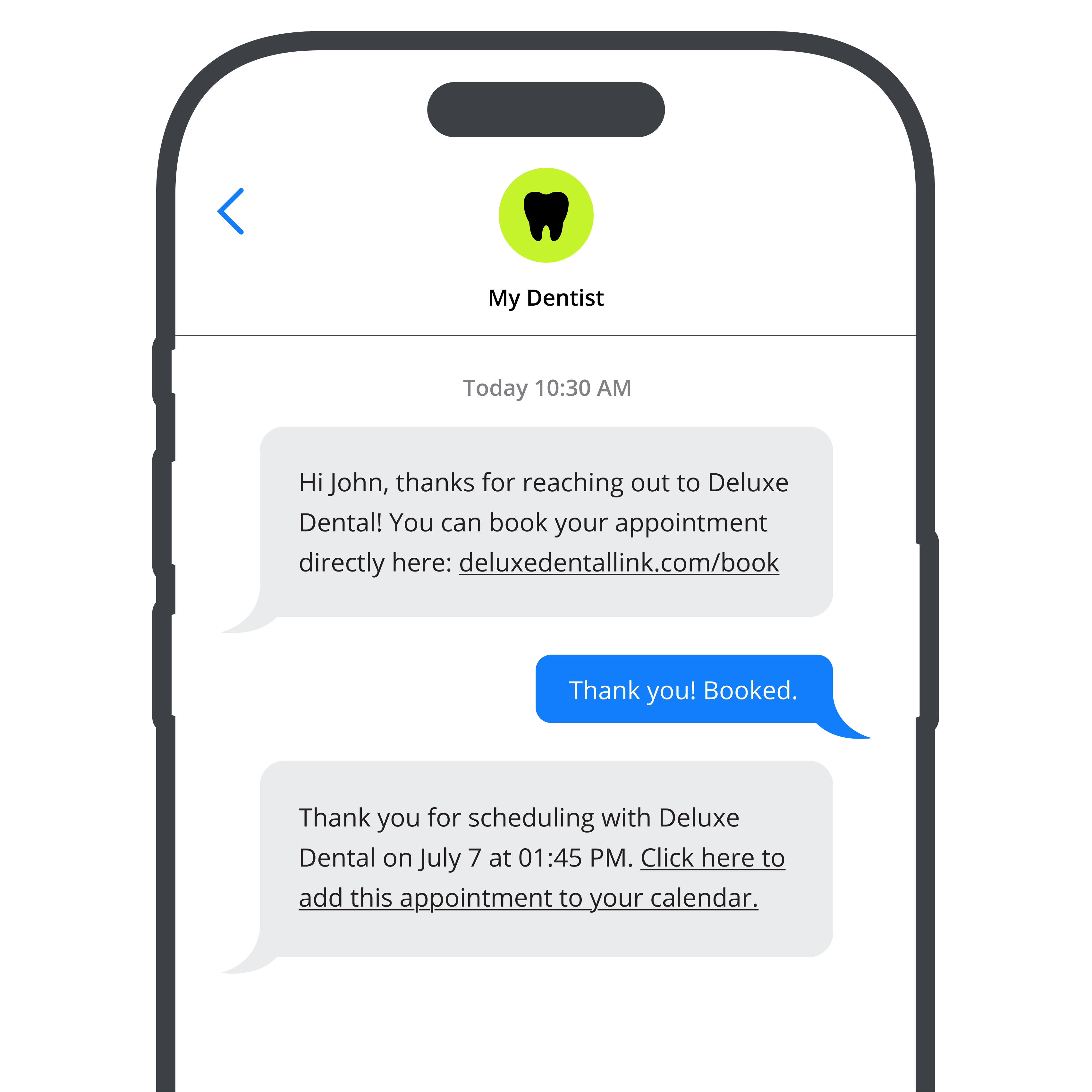
Example of automated patient communication
2. Contact Rate
What it is: The percentage of new inquiries that turn into live conversations (by phone, text, or email).
Target: A consistently high contact rate that doesn’t drop when volume spikes or after hours.
Why it matters: If this dips, it’s a sign that messages are being missed, routed incorrectly, or lost outside office hours.
3. Time to Book
What it is: The time between a patient’s first inquiry and when their appointment is actually scheduled.
Target: As short as possible, especially for high-intent leads (e.g., same day or next day for urgent needs).
Why it matters: Longer booking times create more chances for patients to drop off, schedule elsewhere, or forget to follow through.
4. Cadence Compliance
What it is: How consistently your team follows the agreed follow-up schedule (e.g., number of touches over a set period).
Target: High adherence to your playbook (for example, first reply within 10 minutes, then X follow-ups over Y days).
Why it matters: A friendly, consistent cadence keeps your practice top of mind and shows patients you’re serious about earning their trust.
5. Conversion Rate to Appointment
What it is: The percentage of inquiries that end up as booked appointments.
Target: Continuous improvement over time; this is your “bottom-line” speed-to-lead metric.
Why it matters: This tells you if your follow-up is actually working. You might be fast, but if the conversion rate is low, your messaging or process needs work.
6. No-show or Confirmation Lift
What it is: The impact of timely follow-ups and reminders on whether patients show up for their appointments.
Target: Lower no-show rates and higher confirmation rates after you improve your outreach.
Why it matters: A quick confirmation or reminder can be the difference between a filled chair and lost revenue (especially for new patients).
How Slow Response Times Hurt New Patient Acquisition
When new inquiries sit unanswered, the impact reaches beyond a single missed call.
A Harvard Business Review analysis of 15,000 leads and 100,000 call attempts found that companies that responded within an hour were several times more likely to qualify the lead than those that waited longer.
Slow follow-up effects could include:
Lead decay and schedule leakage. The longer you wait, the more likely potential patients are to schedule elsewhere, leaving open time that could have been filled.
Poor patient experience. Delayed or inconsistent replies make patients question how attentive or organized your practice is. That hesitation starts before they ever walk through the door.
Operational drag. Chasing missed calls and manually tracking messages pulls focus from patient care and adds stress to your team’s day.
7 Steps to Accelerate Speed-to-Lead Before Next Quarter
Phone-first systems leave gaps during busy and after-hours periods, slowing response times. On top of that, inquiries arrive through multiple disconnected channels, making it easy for important messages to slip through.
A well-known MIT/InsideSales study on 15,000 web leads found that contacting a lead within five minutes made teams dramatically more likely (up to ~100×) to reach and qualify that lead compared to waiting half an hour.
These seven actions help teams close gaps and convert inquiries into booked appointments.
Audit intake. Identify every source of new patient inquiries and where they land. Look for gaps or delays in how messages are received and routed.
Set SLAs. Define clear expectations for response time, such as replying within ten minutes during office hours and sending an immediate automated message after hours.
Templatize replies. Draft ready-to-send SMS and email responses for common services. Include booking links or clear next steps so staff can respond quickly without starting from scratch.
Centralize your queue. Keep all incoming messages in one place for easier visibility, assignment, and tracking. A single queue ensures nothing slips through the cracks.
Automate after hours. Use automation to acknowledge messages, set expectations, and capture intent while interest is high. This keeps leads warm until your team is back online.
Enable self-scheduling. Allow patients who are ready to book to pick a time directly from their device, reducing back-and-forth and keeping schedules full.
Review weekly. Monitor response times, contact rates, and conversions. Use those insights to coach your team, refine workflows, and keep improving speed-to-lead.
Patient Link: How Doctible Bridges the Gap
When you improve speed-to-lead, you see measurable results across your practice:
Schedules stay full because inquiries are answered while interest is high.
Patients feel more confident in your care thanks to quick, thoughtful communication.
Marketing dollars go further as faster follow-up drives higher healthcare lead conversion and stronger ROI.
A JAMA Network Open study of outpatient physicians found that responsiveness to patient messages and workload patterns were significantly associated with patient satisfaction scores on Press Ganey surveys.
Patient Link brings every new inquiry into one organized queue and automates fast, personalized responses so no patient goes unanswered. It helps your team respond in minutes, follow up consistently, and turn more inquiries into booked visits.
How Patient Link Helps You Respond Faster
Each feature is designed to shorten response times, keep leads from slipping through the cracks, and turn more inquiries into booked appointments.
Feature
What it does for your team
Instant capture & routing
Pulls all inquiries (forms, voicemail, chat) into one shared queue with clear alerts so leads are handled quickly and don’t slip through the cracks.
Automated first response
Sends instant text or email replies that acknowledge the inquiry, set expectations, and invite the patient to take the next step.
Two-way texting & smart nudges
Enables secure text conversations and friendly reminders that answer questions, share details, and guide patients toward booking.
Self-scheduling & booking links
Lets ready-to-book patients choose a time that works best for them, reducing phone tag and filling openings faster.
After-hours coverage
Captures leads when the office is closed with automatic replies that confirm receipt, set expectations, and queue messages for next-day follow-up.
Tracking & dashboards
Provides real-time visibility into response times, contact rates, and conversions so you can spot delays and improve results quickly.
Getting Started with Patient Link
Building a faster, more reliable follow-up process doesn’t have to wait. Patient Link makes it simple to respond sooner, stay consistent, and turn more inquiries into booked visits.
Get quick answers to common questions about speed to lead and how Patient Link keeps new patient inquiries moving forward.
Speed to lead is the time it takes your practice to respond after a new patient inquiry. It applies to every communication channel and often determines whether that patient books with you or someone else.
Most patients choose the first provider who replies clearly and promptly. A faster response builds trust, reduces missed opportunities, and makes your marketing spend more effective.
Doctible’s Patient Link automates follow-up across every inquiry source. It captures messages in one queue, sends instant responses, and helps your team turn inquiries into confirmed appointments.
Yes. Patient Link automatically replies to inquiries that come in when the office is closed. It sets expectations for when your team will follow up and keeps patients engaged in the meantime.
Absolutely. Patient Link includes dashboards that show response times, contact rates, and conversion metrics so you can monitor progress and coach your team effectively.
Bailyn, E. (2024, March 7). Patient Conversion Rate by Practice Type: 2025 Report. First Page Sage. https://firstpagesage.com/reports/patient-conversion-rate-by-practice-type/
Norton, C. (2025a, September 10). How to Unify the Patient Journey from Search to Schedule. Doctible. https://www.doctible.com/blog/seamless-digital-journey-for-new-patients
Norton, C. (2025b, October 2). 8 Tasks Your Front Desk Should Never Have to Do Again. Doctible. https://www.doctible.com/blog/front-desk-tasks-automation
PwC’s 2025 US Healthcare Consumer Insights Survey: The consumer-first era of health. (2025, October 20). PwC. https://www.pwc.com/us/en/industries/health-industries/library/healthcare-consumer-insights-survey.html
Updated on:
April 27, 2026
See Doctible in action.
If you want the best digital patient engagement and marketing platform, you need Doctible.